Thanks to the United Voices in Action program, IDPs hosted by the Zakarpatska Oblast can count on the support of local communities
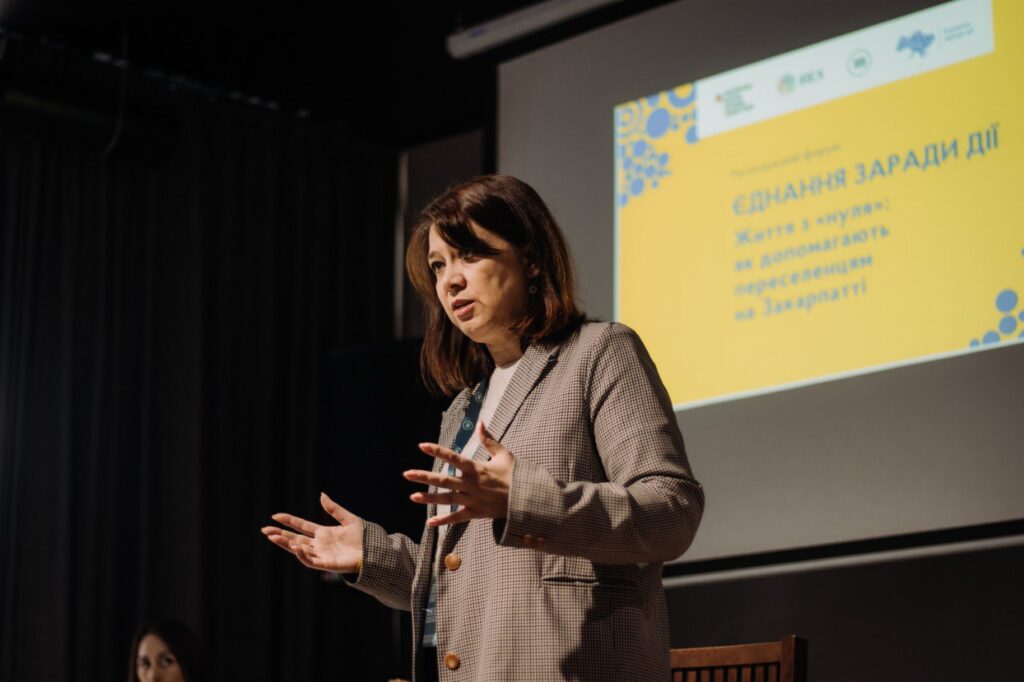
According to the latest data, there are 4.8 million internally displaced persons in Ukraine. Many of them moved to the west of Ukraine, particularly to the Zakarpatska Oblast. Anzhela Babkina, a member of the IDP Council in Uzhhorod and coordinator of the United Voices in Action program in the Zakarpatska Oblast, implemented in Ukraine by IREX together with the Charitable Organization Stabilization Support Services and with the support of the U.S. Department of State, told what makes this oblast special in this context, what challenges the locals face and what internally displaced persons need.
How many people have been hosted by the Zakarpatska Oblast since the beginning of the full-scale war?
Currently, the Zakarpatska Oblast has received more than 300 thousand internally displaced persons, according to unofficial figures provided by the leadership of the Zakarpatska Oblast Military Administration. There are about 150 thousand officially registered IDPs. This is a considerable amount of work, as the Zakarpatska Oblast is one of the smallest regions with a population of just over a million people.
At the same time, Uzhhorod is one of the smallest regional centers in Ukraine, with a population of 115,000, part of whom work abroad. The 28 thousand officially registered IDPs in Uzhhorod is a significant number, which can be safely doubled because many people have not officially registered.
What conditions do IDPs live in, and what do they need?
Internally displaced persons face the biggest problems with employment and housing. There have always been few houses available for rent in the Zakarpatska Oblast. The increase in demand led to higher prices. There is also a lack of jobs. But the authorities are gradually solving all these problems. IDPs get settled in Collective Centers in the region. If there are more waves of resettlement from the active combat zones, the Zakarpatska Oblast – both the authorities and the public – will accept everyone, although there are certain challenges.
We also have a lot of relocated enterprises. The Zakarpatska Oblast is one of the regions where businesses have been actively moving for security reasons. And there is a certain benefit to this because now they invite locals and IDPs to work.
After the war, some people will stay where they relocated. Is the oblast ready for this?
Yes, the war continues, but we have to prepare for life after the victory. Some people and businesses that have relocated have nowhere to return to. Therefore, they are already receiving support and certain preferences, such as premises. The local authorities are committed to helping people settle in.
There are some stories that are amazing. In the summer, I was in the small village of Ilnytsia and saw two relocated businesses. One of them was from the Kharkivska Oblast and was producing clothes for civilians. It quickly reorganized and started sewing clothes for the war effort. The company was provided with premises: on the ground floor, they had the equipment they had managed to evacuate. The second floor has housing for employees. That is, not only did the business leave with its equipment, but so did the employees and their families. There were children, old people, and cats and dogs!
Even if the war ends tomorrow, it will be impossible to return home at once. Because demining, infrastructure restoration, etc., will have to be carried out. Many people will stay and be useful for communities, businesses, and the Zakarpatska Oblast and Ukraine in general. This is a huge resource for the development of the region.
The more time passes, the more likely people are to stay here. Especially if they settle down and solve their housing and employment problems.
Are there conflicts between communities and IDPs? If so, how can they be prevented?
Presumably, the more people came, the more discomfort the locals felt. Accusations against IDPs who create “domestic discomfort” have emerged. In my opinion, the Zakarpatska Oblast is now going through the same stage as the oblasts that received many IDPs in 2014-2016: Zaporizka Oblast, Kharkivska Oblast, government-controlled parts of the Donetska and Luhanska oblasts. But we can learn from their experience: not to divide people into “friend or foe,” to hold joint events, to try to engage everyone, to explain, to talk.
At the beginning of the full-scale invasion, it happened that men who brought their families were not allowed to spend the night. Some locals saw this as a way of avoiding the war, saying that they were “sitting it out.” There were cases when rural communities did not register men as IDPs in violation of the law. Subsequently, there have been significantly fewer incidents, but such cases will continue to occur. The situation needs to be addressed: by the authorities, CSOs, and the communities themselves.
An IDP Council has recently started working in Uzhhorod. What will it do, and how will it help?
Although our IDP Council is one of the youngest in Ukraine (established on December 14, 2022), it has strong potential. It was created thanks to the United Voices in Action program, which aims to unite IDPs and the community and effectively address the problems they face.
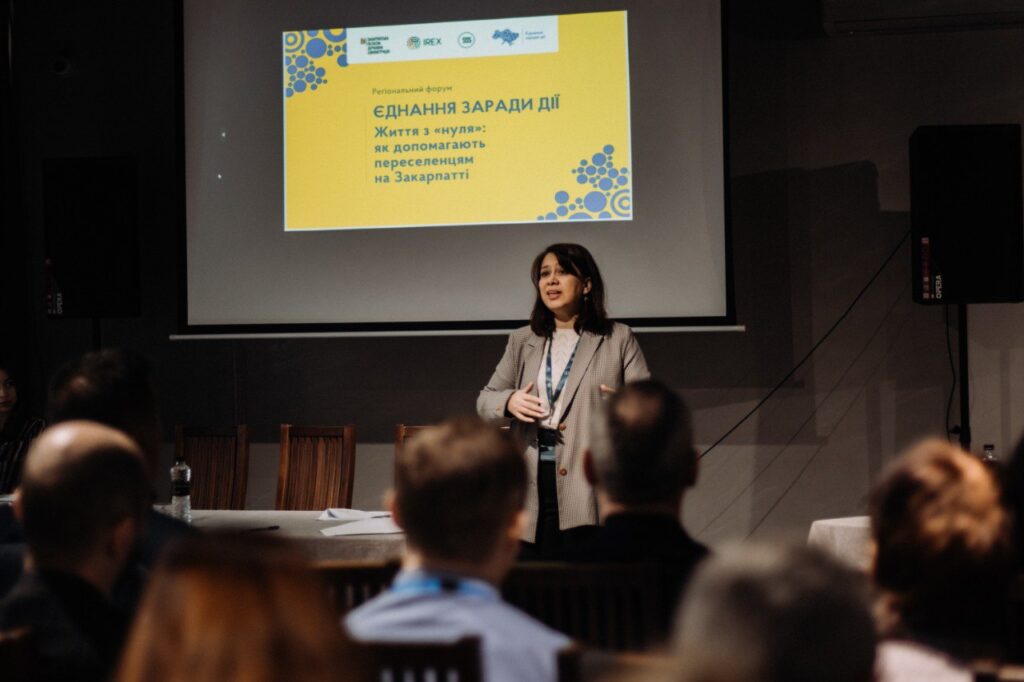
Since there are many IDPs in the city, the Coordination Council in Uzhhorod includes IDPs and representatives of various CSOs. Both local ones, which have been involved in this field since 2014, and those created by internally displaced persons themselves. In addition, there are relocated organizations that represent a certain group of people and can speak about their own needs, and have a positive experience of integrating a large number of IDPs into communities. This is valuable.
In the future, the IDP Council will deal with various areas: work with children, the humanitarian sphere, psychological support, the system of accessibility and inclusion, and housing issues. For example, not all children can now go to local schools or kindergartens.
One of my dreams in the context of the Coordination Council’s activities is a kindergarten and a school. Yes, it is very difficult, but the Uzhhorod City Council has already done a lot: there is a place, project documentation, and money for construction. Both children of IDPs and locals will attend these institutions. If the project is implemented, it will be one of the Council’s significant results and a great example of social cohesion.
How is the United Voices in Action project helping IDPs right now?
We provide more than fifty consultations per month. A lawyer helps to solve issues related to passportization, restoration of documents, payments, utility meters, applications, appeals to the authorities and even drafts letters of request for free.
The range of our activities is expanding, and we are increasingly assisting our IDPs with individual cases. For example, once we were looking for a rather rare medicine. We also had to involve our friends to find the medicines and deliver them to the woman. We also work with alimony.
We separately advise the most vulnerable categories on how to receive financial assistance from the Zakarpatska Oblast Council, collect documents, and apply for payment. It provides for personal interaction. For other questions, we can advise by phone, by e-mail, and even via messengers. We do our best to help people find answers to their questions.
And once a month, we have a mandatory on-site consultation. We announce the time and place of the meeting with a lawyer in advance. At the specified time, we arrive at the place where the IDPs live.
We also have a manual with useful information for IDPs. It is available not only in print but also in electronic form. The manual was created within the framework of the United Voices in Action program with the support of the Ministry of Digital Transformation and the Ministry of Reintegration of the Temporarily Occupied Territories. It contains answers to most of the questions related to social protection in an easy-to-understand form. In particular, regarding the registration of IDPs, receiving assistance, benefits and pensions, housing, etc. Every community needs such information.
What plans do you have for the near future?
First, to work in a consistent manner with the IDP Coordination Council. We also have ambitious plans to create an IDP Council in Mukachevo. We have already held a large regional forum in cooperation with the oblast administration to present best practices.
United Voices in Action is a program that brings together IDPs, community members, government representatives, and the media and provides comprehensive support for the development of local and national plans for IDP integration and stabilization in Ukraine.
Read the material on the website “Zaxid.net“