In Uzhhorod, the United Voices in Action initiative, implemented by the international organization IREX in partnership with the Charity Foundation Stabilization Support Services and backed by the U.S. Department of State, showcased a large-scale study scrutinizing local policies and programs. This study casts light on how IDPs’ rights are respected and their integration into the life of their new communities.
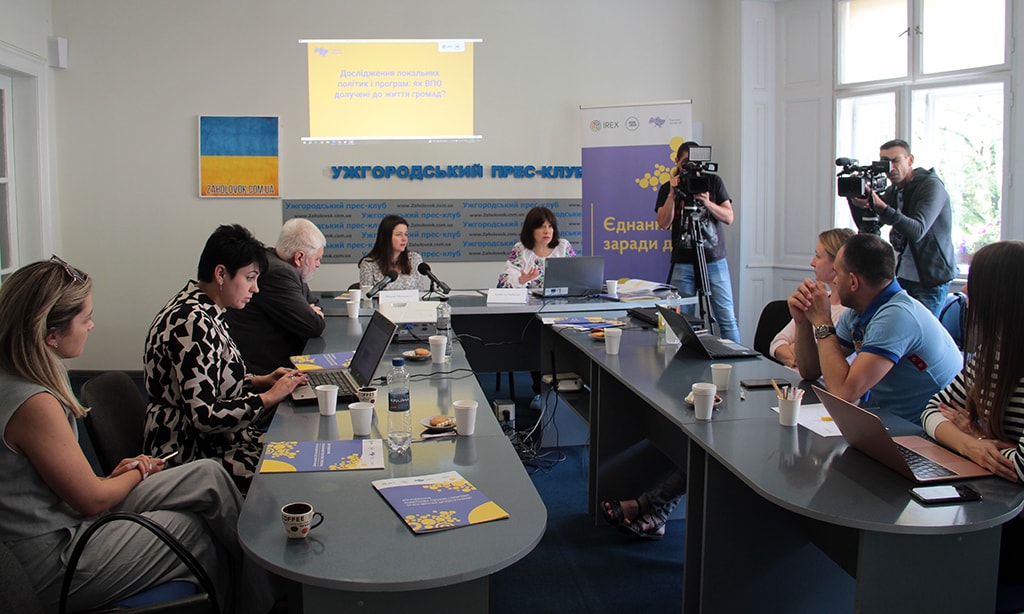
The legal experts involved meticulously examined 193 local legislative enactments from 25 communities across 15 oblasts in Ukraine. In Zakarpatska Oblast, the experts paid particular attention to Uzhhorodska and Mukachivska communities. It has been established that due to ambiguous definitions of “territorial community member” and “permanent residence”, IDPs find their rights curtailed. They often can’t engage in local decision-making or access certain social benefits. This was explained by Anzhela Babkina, regional coordinator of the United Voices in Action program in Zakarpatska Oblast.
“The majority of statutes don’t consider IDPs as part of the local community. This means they’re excluded from specialized programs meant for local community members, leading to a form of discrimination,” Anzhela Babkina elaborates. “There are certain restrictions on participation in community life. IDPs are barred from general assemblies, public consultations, voting on participatory budget projects, and using other instruments of local democracy.”
However, Babkina also highlighted some positive practices. These should be considered when drafting local regulations aimed at supporting vulnerable groups, including IDPs.
Uzhhorod has four dedicated local programs. Mariya Mendzhul, the regional lawyer for the United Voices in Action program in Zakarpatska Oblast, spoke on one such program established in 2022. It offers support and protection for IDPs.
Maria shared, “As of June 2023, the city had 28,000 officially registered IDPs. Over the previous year, the Social Services Center catered to over 16,000 of them. Temporary housing or help in securing it, alongside tangible aid like food, hygiene essentials, and clothes, are the most sought-after services by IDPs.”
In contrast, the expert mentioned, Mukachevo doesn’t have IDP-specific programs. Still, there’s a scheme offering supplementary social and health support to its residents. IDPs registered in Mukachevo can access it, even obtaining medical assistance worth 10,000 hryvnias if needed.
While IDPs in Uzhhorod and Mukachevo play roles in community activities, mainly via Coordination Councils for Internally Displaced Persons and by working in local administrations, this doesn’t equate to direct local decision-making participation. To make that a reality, community statutes need revisions.
Consequently, the research team has developed recommendations for local authorities to revamp policies, ensuring they encompass IDPs’ needs and rights. This includes possible amendments to community statutes and the streamlining of regulations that determine entitlements for specific population segments.
Beyond Zakarpatska Oblast, these findings will be presented in the 14 other studied oblasts. A summary of the recommendations will be sent to the Ministry of Reintegration of Temporarily Occupied Territories and other relevant national and local authorities.