In Kropyvnytskyi, experts of the United Voices in Action initiative, implemented by the international organization IREX in partnership with the Charity Foundation Stabilization Support Services and backed by the U.S. Department of State, showcased a large-scale study scrutinizing local policies and programs. This study casts light on how IDPs’ rights are respected and their integration into the life of their new communities.
In total, the lawyers reviewed 193 legal acts in 25 communities across 15 oblasts of Ukraine. They found out that IDPs are deprived of the opportunity to participate in local decision-making and enjoy certain social benefits. The reason is gaps in the community statutes and local targeted programs that define the concepts of “permanent residence” and “place of residence registration.”
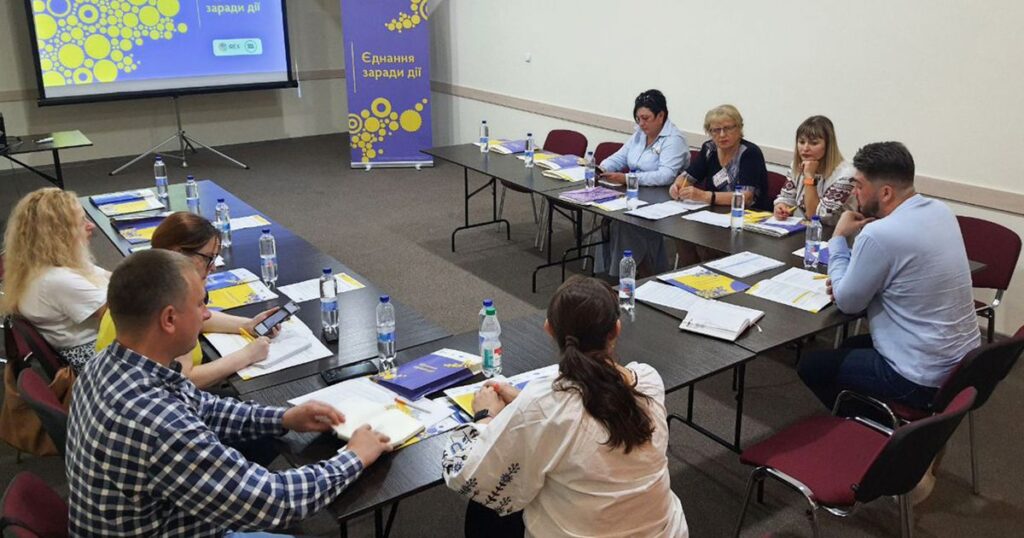
This is exactly the situation in Kropyvnytskyi, experts note. According to the local statute, a territorial community consists of all residents who are united by permanent residence within the city and whose place of residence is registered in accordance with the procedure established by law. Only under these conditions do they have the right to participate in self-government. This was stated by Denys Skvortsov, the regional lawyer of the United Voices in Action program in Kirovohradska Oblast. However, in his opinion, this problem is not difficult to solve.
“The legislation has established a definition of IDPs. It is enough to supplement local regulations with the definition that an IDP is a person who falls under the criteria of the law ‘On Ensuring the Rights and Freedoms of Internally Displaced Persons’. For local authorities, this is an opportunity to demonstrate their commitment to the law, and for us to avoid legal uncertainty about whether a person is a member of the community or not. After all, we are all equal in the rights we have and the responsibilities we fulfill,” said Denys Skvortsov.
The researchers also identified some successful practices, including the replacement of lost documents without paying an administrative fee, a 50% discount on art school tuition for internally displaced children, social taxi services, and free public transportation. To make it easier to access the benefits, it would be advisable to create an IDP card for new community residents, added Denys Skvortsov.
“For example, an IDP card may contain information that identifies a person. This data will be read during preferential transportation, so IDPs will not need to carry the original IDP certificate with them. It will also make it easier to receive social services, humanitarian and financial assistance, etc.”
In addition, IDPs are involved in community life and interaction with the authorities through the Council for Internally Displaced Persons. At the same time, the Kropyvnytskyi City Council approved the Comprehensive Program of Social Support, Adaptation, and Integration of IDPs for 2023-2025.
“The program was developed together with the Department of Social Policy and the deputy corps. We are very pleased that it is finally here. After several stages of preparation, we discussed it with civil society organizations and made some significant suggestions, which made it effective. We are pleased to see that the study covers this program,” said Natalia Cherednichenko, Head of the Health, Education, Social Policy, Culture, and Sports Committee of the Kropyvnytskyi City Council and a member of the city council.
Currently, housing, employment, humanitarian, and financial assistance remain the most pressing needs of IDPs. Rehabilitation and psychological services, as well as training at the city employment center, are in great demand among IDPs.
The community does not divide residents into IDPs and locals, and some discrepancies in social support programs will be corrected. This was stated by Olena Kostenko, Deputy Director of the Social Policy Department of the Kropyvnytskyi City Council.
“After this study, we will introduce amendments to our programs. We are grateful that you have raised this issue, conducted an in-depth analysis, and provided us with your suggestions. We ourselves have noticed that there are discrepancies in the programs, they need to be revised, and this is an enormous amount of work. However, we will take into account all the suggestions. We hope that the IDP Council will help us, and we will update the programs,” said Kostenko.
Sometimes local programs are flawed for two reasons: an outdated method of program development based on budgetary resources, and unexamined needs of the target audience, said Liubov Lukyantseva, president of the Hromadski Initsiatyvy Association and member of the IDP Council under the Executive Committee of the Kropyvnytskyi City Council.
“If there is a targeted program for IDPs, the needs of IDPs should be identified first. Who these people are (women, men, children), how many of them there are, whether they are able-bodied, pensioners, people with disabilities. If we find out, for example, that 85% of those registered are female IDPs, then perhaps such programs should include more activities designed for them. This also applies to children, youth, and people with disabilities. I would like the proposals to be discussed at the IDP Council. After all, if we are creating programs for IDPs, we should involve them in their development,” noted Lukyantseva.
Anton Antonov, the regional coordinator of the United Voices in Action program in Kirovohradska Oblast, also said that the results of the study should be taken into account when developing local regulations aimed at IDPs.
“Our main goal is to help each other, not just to prove that something is wrong in the community. Based on the results of today’s meeting, we will prepare recommendations for improving policies and programs to make them take into account the interests of IDPs. We will be grateful if the local authorities respond to them,” Anton Antonov summarized the event.
In particular, the researchers propose to amend the community statute, local targeted programs, and regulations that define the procedure for benefits and assistance to certain categories of people.
Beyond Kirovohradska Oblast, these findings will be presented in the 14 other studied oblasts. The United Voices in Action program will send a summary of the recommendations to the Ministry of Reintegration of Temporarily Occupied Territories and other relevant national and local authorities.