Since the beginning of the Russian invasion of Ukraine, Cherkaska Oblast has housed over 250,000 internally displaced persons, with more than 100,000 officially registered as such. The oblast, like other relatively safe areas, grappled with the lack of social housing.
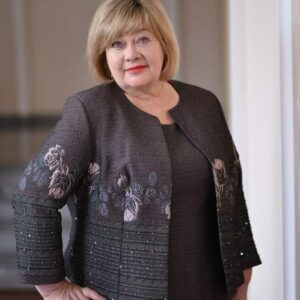
Larysa Khodakovska, the coordinator of the United Voices in Action program in Cherkaska Oblast, implemented by IREX together with the Charity Foundation Stabilization Support Services and with the support of the U.S. Department of State, provides insights into the challenges faced by IDPs and the solutions being implemented.
What challenges do IDPs encounter in Cherkaska Oblast?
A prominent issue is the acute shortage of housing for IDPs. Many have lost homes and possessions and are financially unable to afford rent. With a lack of social housing for IDPs, this issue was substantial. Consequently, local authorities, NGOs, and charitable organizations refurbished school buildings to provide temporary housing.
Where have people been resettled?
A significant number of IDPs have been accommodated in rural areas. Some found the adaptation to rural living conditions challenging. For city dwellers, adjusting to wood-heated stoves and fetching water from wells was a novelty. Despite the difficulties, they had to adapt. The greatest difficulties are for disabled individuals, for whom proximity to hospitals is crucial, necessitating the creation of more urban social housing.
Moreover, IDPs in rural areas do not receive sufficient humanitarian aid. While several charitable foundations and NGOs provide food and clothing to IDPs, aid distribution primarily occurs in cities, and those residing in remote villages, who arguably need aid the most, receive assistance less frequently, sometimes only one kit per month.
Are there adequate job opportunities for IDPs in Cherkaska Oblast?
Regrettably, no. Many of the people relocated from Donetska and Luhanska oblasts are skilled in mining and steel plant operations, industries absent in our oblast. Cherkaska Oblast is an agricultural region. While our employment center offers retraining for new professions and the regional authorities propose retraining, most people decline.
On the other hand, entrepreneurs are more proactive. They run successful businesses, pay taxes, and support orphans and the children of IDPs.
Your program is known to offer legal support to IDPs. Can you provide more details?
This is a significant area of our work. Under the United Voices in Action program, we visit settlements where IDPs live to provide free legal consultations. Our lawyer handles queries relating to housing restoration, guardianship, and delayed payments, providing 10-15 consultations daily. To receive legal assistance from the United Voices in Action program, you need to complete an online application form specifying your contacts and the nature of your request, after which our lawyer will reach out to you.
We’ve placed information boards with useful information in dormitories and shelters, explaining, in a concise and accessible manner, the actions required in each case. We’ve also published a manual with useful information for IDPs, accessible in print and digitally on our program’s website. This guide, created within the United Voices in Action program with the support of the Ministry of Digital Transformation and the Ministry of Reintegration of Temporarily Occupied Territories, covers most IDP-related questions: IDP registration, assistance, benefits and pensions, housing, etc. This information is vital for every community.
Your organization advocates the creation of IDP Councils in Ukraine. How do they assist IDPs?
The IDP Council, as an advisory body, identifies, organizes, and addresses problems faced by IDPs, ranging from housing, employment, children’s education, etc.
Operating under local government, the IDP Council serves as a consultative, advisory, representative, and mediating body. It consists of IDPs, NGOs, and government representatives. It organizes the distribution of humanitarian aid, identifies systemic problems encountered by IDPs, and aids in their resolution.
Additionally, IDP Councils should encourage IDPs to actively participate in the social and political life of their city or village. We recently hosted a forum dedicated to the integration of IDPs in Cherkaska Oblast. We discussed legal support, employment, psychological and informational support for IDPs, among other issues. All attendees backed the idea of establishing an IDP Council under the Cherkaska Oblast Military Administration and local authorities.
Now, Cherkasy has an active IDP Council aiding IDPs, and another one in Uman is in the process of being established.
Source: 18000.com.ua