In Lutsk, displaced actors performed a Forum Theater play for IDPs and local residents, representatives of NGOs, charities, and local authorities. The Forum Theater is a unique format that provides for direct audience involvement. Thanks to this, people with different backgrounds often find unconventional solutions to the problems discussed in the play.
The event was held as part of the United Voices in Action program, implemented by International Organization IREX in Ukraine together with the Charitable Organization “Charity Foundation “Stabilization Support Services” and with the support of the U.S. Department of State.
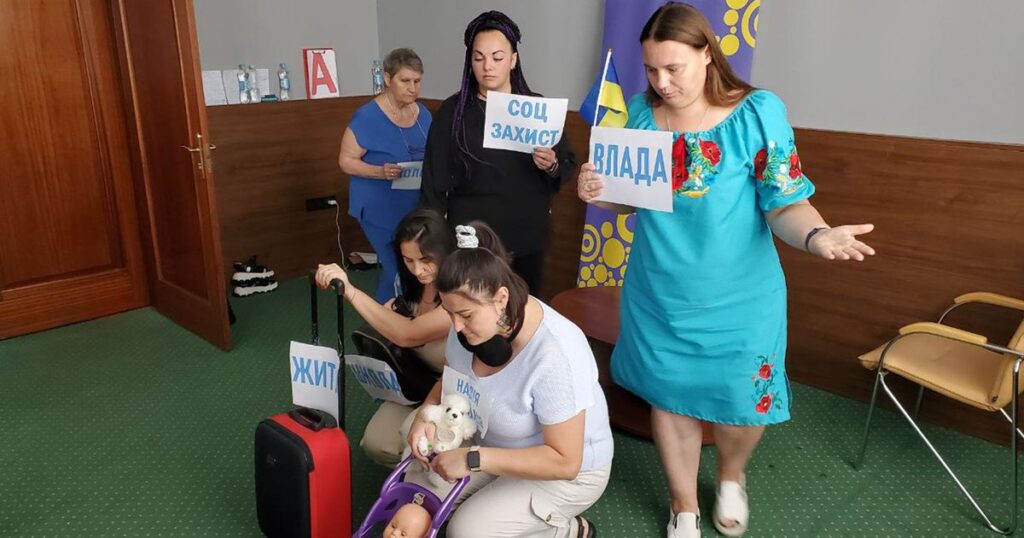
The play is titled “In a Circle”. It tells the story of an IDP mother who escapes occupation with her two children. The bags and suitcases the protagonist carries serve as metaphors for the immense burdens and challenges confronted by IDPs. At first, social services, charitable organizations, and volunteers take some of the burden away, but eventually, she has to carry it all herself, meaning she has to take care of all the family’s needs on her own. Iryna Pylypenko, the regional coordinator of the United Voices in Action program in Volynska Oblast, had never expected that an event like this would raise so many important and pressing issues.
“The Forum Theater is a new and exciting kind of performance. I am an IDP myself, so it was hard to hold back my tears. The young women performed beautifully, they were great. Yes, they were a little nervous, but they tried very hard. When the actors were replaced, when the audience was actively involved in the performance, the discussion became very lively. Even the air raid alert, which forced us to go down to the shelter, did not change this.”
According to Nataliya Teslyk, the project coordinator of the United Voices in Action program, this Forum Theater performance raised the complex issues that IDPs face and served as another opportunity to establish communication between IDPs, government officials, and proactive citizens.
“Integration into a new community is often a challenge for IDPs, more so for families with children. Their primary concern is their children’s safety and welfare. Securing housing is a significant hurdle, and forging a new life under often daunting circumstances raises a multitude of concerns. It emphasizes the dire need for tangible support. It is crucial for Ukrainians to unite instead of dividing into IDPs and local community members,” elucidates Teslyk.
The primary concerns pinpointed by both the audience and actors include the need for social housing and a robust support system for IDPs via the IDP Council. This Council is envisioned as the pivotal coordinating body, liaising with local authorities, enhancing the bond between IDPs and the authorities, and collaboratively resolving pressing concerns. Efforts are currently underway to establish such a Council at the regional level.
“Consider IDPs as flowers that have been uprooted. To plant them anew in a different environment, the right conditions are essential. This is a task not just for the IDPs but for local authorities as well,” remarked Yuliya Kriuchkova, a psychologist from Mariupol.
Job opportunities remain a significant concern for IDPs. Often, employment centers lack comprehensive data about available roles within the community. This is where local authorities should step up, voiced Ivanna Horbachuk, the head of the Christian Association of Young People and Family-Temple NGO:
“IDPs are an untapped asset for community growth. But due to information gaps, they are sadly misperceived as needy.”
Echoing the sentiment, Iryna Pylypenko, the regional coordinator for the program, noted the attendees’ enthusiastic participation during and after the performance. This proves once again that they care about each other and can unite to work together to improve their situation.
Similar theatrical events are being organized across 15 Ukrainian oblasts. More than 52 thousand IDPs are officially registered in the Volynska Oblast, all in need of integration support within their new communities.