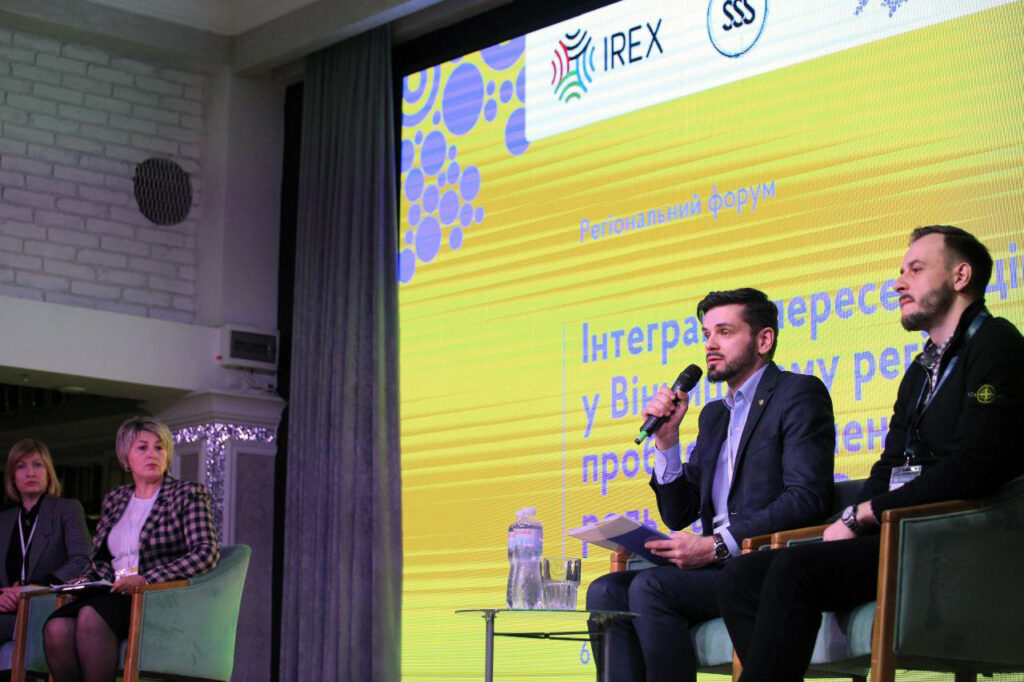
Ways to help internally displaced people were discussed during the regional forum Integration of IDPs in the Vinnytska Oblast: Problems, Solutions and the Role of the IDP Council. The event was organized by the United Voices in Action program. Since the beginning of the full-scale invasion, the Vinnytska Oblast has hosted about 170,000 Ukrainians, of whom almost 46,000 have remained in Vinnytsia. Most people came from the Donetska, Kharkivska, and Kyivska oblasts.
The forum has become a platform for communication between government, business, and community representatives. After all, joint efforts will help IDPs stabilize their lives in a new place. One of the instruments in this cooperation is the IDP Coordination Council. Currently, working groups on the integration of internally displaced persons are already active in the region, said Valentyna Voitkova, director of the Social Policy Department of Vinnytsia City Council:
Eleonora Rudenko
An integral part of the IDP integration process is the creation of IDP Councils. They will be able to collect and communicate to the authorities the current issues and needs of IDPs, help improve the interaction of all stakeholders and participate in developing effective programs at the local level. IDP Councils should become a platform for the exercise of civil and political rights of internally displaced persons, in particular, the constitutional right to participate in the management of public affairs.
Currently, the Oblast Interagency Council on Family Issues, Social Support for Families of Defenders, Integration of Internally Displaced Families (individuals), Gender Equality, Prevention of Domestic Violence, and Combating Human Trafficking is active in the region. It is composed of 5 working groups, each of which deals with a specific area of population support. Namely, working groups on social policy and assistance to the families of Defenders of Ukraine; on issues of internally displaced families (persons); on ensuring equal rights and opportunities for women and men; on combating human trafficking; on preventing domestic and/or gender-based violence. Therefore, the integration of IDPs into the community is one of the priority tasks, said Valentyna Voitkova, director of the Social Policy Department of the Vinnytsia City Council:
Valentyna Voitkova
This year, we have already held two meetings of the working group on IDPs within the interagency council. We need to sit down with international partners and interact with local actors to develop a concrete strategy for integrating people into local communities.
In addition, working groups addressing the needs of IDPs have been established at the level of all 63 territorial communities in the region, the head of the department noted. The Humanitarian Center for Clothing and the Vinnytsia City Center for Humanitarian Aid continue to provide material support to families, providing food, hygiene products, clothing, and footwear to nearly 25,000 families.
Advocacy remains a key means of fighting for the rights of IDPs, emphasized Mykhailo Kozyr, a member of the Public Council at the Ministry of Justice. Currently, the most pressing problem is the provision of housing, especially for those who have completely lost their homes. According to the expert, it is possible to resolve this issue. It is necessary to create housing pools for the temporary accommodation of IDPs and the construction of social housing:
Mykhailo Kozyr
Undoubtedly, the creation of such a pool requires funds. So, first of all, communities need to analyze their own financial capabilities and find additional resources… The next problem is utility bills. IDPs do not use these services and do not understand the civil law consequences for non-payment. In addition, there are unresolved cases when during the occupation, the population used electricity that the regional power company did not actually supply.
About one-third of all appeals to lawyers concern social benefits and compensation for destroyed or damaged housing, said Kozyr. Issues regarding the recovery of lost documents also need to be addressed.
Employment of new residents of the Vinnytska Oblast and business protection are also among the priorities of the local authorities. According to Serhiy Borzov, head of the Vinnytska Oblast Military Administration, 270 companies have relocated to the region since the beginning of the war: 156 individual entrepreneurs and 114 legal entities. Supporting entrepreneurs not only strengthens the community’s economy but also helps create new jobs and fill the budget for the region’s development.