In Rivne, experts of the United Voices in Action initiative, implemented by the international organization IREX in partnership with the Charity Foundation Stabilization Support Services and backed by the U.S. Department of State, presented a large-scale study of local policies and programs. This study casts light on how IDPs’ rights are respected and their integration into the life of their new communities.
The legal experts involved meticulously examined 193 local legislative enactments from 25 communities across 15 oblasts in Ukraine. It has been established that due to ambiguous definitions of “territorial community member” and “permanent residence”, IDPs find their rights restricted. They often can’t engage in local decision-making or access certain social benefits. This was explained by Svitnala Bidiuk, regional coordinator of the United Voices in Action program in Rivnenska Oblast.
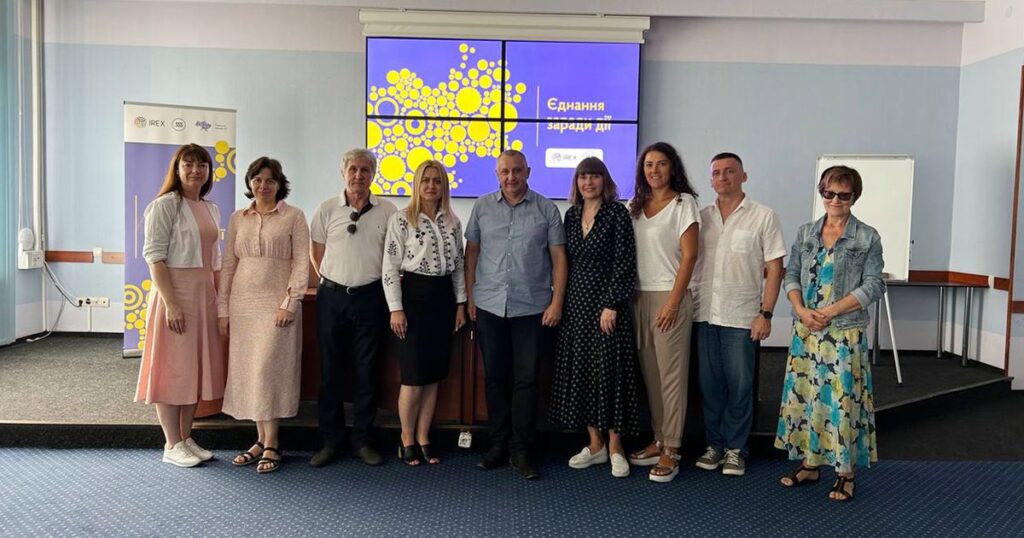
“The study showed that IDPs are limited in their right to participate in local decision-making. They cannot submit their own initiatives, participate in public hearings or general meetings, vote for participatory budget projects, etc.”, said Bidiuk.
According to Serhiy Cherniy, director of the Social Policy Department of the Rivne City Council, more than 19,000 IDPs are currently officially registered in Rivne.
“The city’s social program “Turbota” was amended in the first weeks of the full-scale war and now provides benefits for IDPs. In addition, IDPs can receive the same social services as other residents of the Rivnenska territorial community. Once a week, we hold meetings with IDPs to discuss important issues. These may relate to employment, healthcare, children’s rights, etc. It also helps to identify needs and develop action plans,” emphasized Cherniy.
In addition to the local program, IDPs receive assistance in applying for state social benefits in the shortest possible time. This was stated by Olha Mosiychuk, head of the IDP Department of the State Social Programs Directorate of the Social Policy Department of Rivne City Council.
“Today we have about 9 thousand applicants registered. These include people who receive state living allowance, as well as single mothers, low-income families, and other categories,” Mosiychuk said.
Mr. Cherniy also notes that an IDP registration certificate in the community is equivalent to a city registration, so there is no discrimination against IDPs. The changes that the researchers suggest are already being implemented.
“Rivne’s statute will be amended regardless, because we are a territorial community, and the statute was written for a city. In addition, the “Turbota” program is coming to an end in 2023, and we want to create a separate program for IDPs,” the official added.
He emphasized that such studies are important because they help identify IDPs’ problems that the authorities can solve in the future.
The researchers developed recommendations for local authorities to improve their policies and programs. These include increased consideration of the interests and rights of IDPs. Specifically, to make appropriate amendments to the community statute, local targeted programs, and regulations that define the procedure for providing benefits and assistance to certain categories of the population.
Beyond Rivnenska Oblast, these findings will be presented in the 14 other studied oblasts. The United Voices will send a summary of the recommendations to the Ministry of Reintegration of Temporarily Occupied Territories and other relevant national and local authorities.